
Chapter 1: The Fateful Footnote
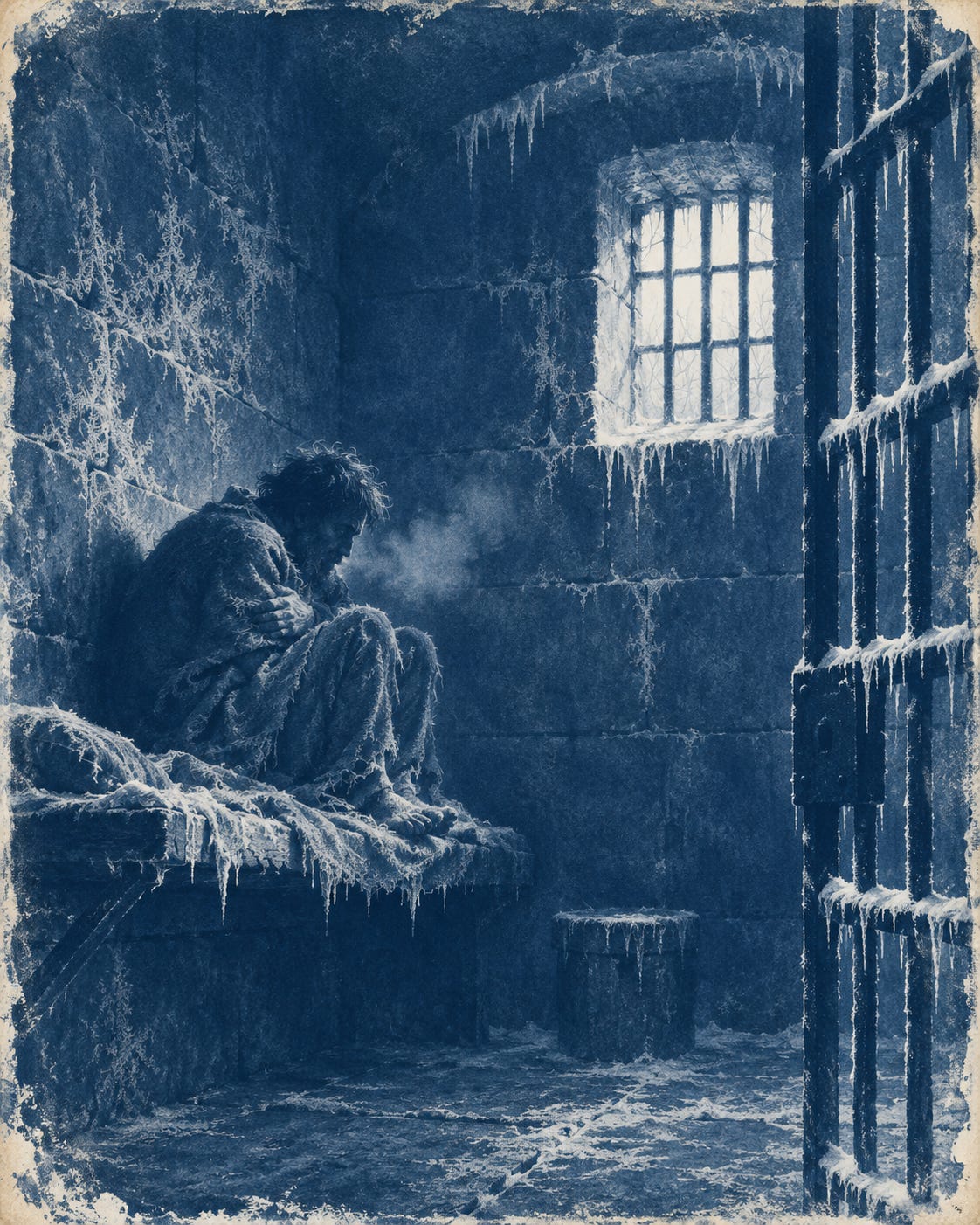
In March 2031, Patrick Davis, a pro se prisoner, sued the warden of his prison, Orlando Ortiz, in the U.S. District Court for the Northern District of Texas. Davis alleged that after he filed a grievance over distasteful prison food, prison officials unconstitutionally retaliated against him by turning down the temperature in his cell. The district court swiftly dismissed the case, ruling that Davis hadn’t alleged that the temperature was so cold as to rise to the level of cruel and unusual punishment, and that Davis couldn’t otherwise bring a claim premised on a chilly prison cell.
Davis filed a motion for reconsideration, insisting that his legal argument was correct. According to Davis, Bibbs v. Early, 541 F.3d 267, 272 (5th Cir. 2008), held that prison officials’ retaliatory decisions to turn down the temperature could be the basis for a retaliation claim, even if the temperature wasn’t unconstitutionally cold. The district court denied the motion. According to the district court, Bibbs established that a claim premised on a cold prison cell—no matter what the basis for the claim—could succeed only if the temperature was unconstitutionally cold.
Davis filed a second motion for reconsideration, insisting his understanding of Bibbs was correct. As evidence, he attached a blurry photocopy of page 272 of the relevant volume of the Federal Reporter he purportedly had obtained from the prison law library.
The court checked Westlaw and determined that it had read Bibbs correctly. It therefore denied the motion as procedurally improper and frivolous. The court struck the exhibit from the docket, pointing out that legal authorities should not be submitted as exhibits and that the purported photocopy did not match the text maintained by the court’s electronic research service. And it sanctioned Davis for having submitted a fraudulent, likely AI-generated image of the Federal Reporter.
Davis appealed to the Fifth Circuit, again attaching the blurry photocopy of the Federal Reporter page to his handwritten filings. The Fifth Circuit struck the photocopy from the docket, explaining that exhibits should not be submitted to the court of appeals. It held in a brief summary order that the district court had not abused its discretion.
Warden Ortiz got wind of the sanctions order. The district court’s conclusion that Davis had used AI implied a serious violation of prison rules: Davis, a violent offender with numerous disciplinary violations, was not permitted to access computers. As punishment, Davis was given two weeks of solitary confinement, followed by a transfer to a maximum-security facility.
Davis filed a prison grievance, insisting that he had never used AI. He claimed he had looked up the case in the physical copy of the Federal Reporter in the prison library, and he shouldn’t have been sanctioned by the district court. The Unit Grievance Investigator summarily denied the grievance, on the ground that Davis was improperly attacking the federal court’s order finding the photocopy to be fraudulent. Davis appealed to Central Administrative Staff, which upheld the denial without comment.
Davis sued his captors again in the Northern District of Texas. He sought money damages for the wrongful placement in solitary confinement and an injunction transferring him out of the high-security facility. Once again he attached the blurry photocopy of the Federal Reporter.
The district court dismissed the claim, finding that prison officials had qualified immunity from money damages because they reasonably relied on the court’s own prior sanctions order. It declared the claim for an injunction to be frivolous.
Davis appealed to the Fifth Circuit, again enclosing the blurry photocopy. The cold-prison-cell case was long over, but Davis’s handwritten brief spent several pages passionately insisting that he could, in fact, bring a retaliation claim based on his cold prison cell.
The staff attorney, Mia Irwin, was bemused by Davis’s unceasing insistence that he was interpreting this random case from 2008 correctly. So she decided to pull out the actual bound volume of the Federal Reporter that Davis kept citing. (Bound volumes were kept in some of the older judges’ chambers for decorative purposes, even though no one had opened them for years.) Accessing the bound volume required a ladder because it was on a shelf near the ceiling.
After Irwin retrieved the bound volume, she compared the relevant page to the prisoner’s blurry photocopy.
They were the same.
She then opened up Westlaw and LEXIS to find electronic versions of the case. The district court had quoted the electronic versions of the case correctly. But the bound volume didn’t match the electronic versions.
She checked PACER to see whether there was any record of the court modifying the opinion. There was. According to PACER, the court had initially issued the opinion that ended up in the actual Federal Reporter. But then, without explanation or prompting, the court had issued a “modified opinion” which altered its reasoning. The modified opinion—not the original opinion—appeared on Westlaw and LEXIS, with no indication that the opinion had been modified.
Weird.
Suddenly Irwin panicked. It wasn’t fair that Davis had been transferred to a maximum-security prison for having accurately quoted the Federal Reporter. But she couldn’t seriously recommend ruling in favor of a pro se prisoner. She would lose all credibility.
So she wracked her brain and figured out a solution. She recalled from a prior case that the Texas prison system had recently instituted a three-step grievance process. At the last step, a grievance had to be submitted to the Executive Director of the Texas Department of Criminal Justice. Davis hadn’t completed this step; he had gone only as far as Central Administrative Staff. So he didn’t exhaust his remedies, which meant that his lawsuit failed. The defendants hadn’t made this argument, but that was OK.
Irwin drafted an unpublished memorandum opinion affirming based on lack of exhaustion. But she included a fateful footnote: “We note that appellant’s purported photocopy of Bibbs v. Early, 541 F.3d 267 (5th Cir. 2008), appears to correspond to the text of the opinion in the bound volume of the Federal Reporter, even though it does not match the version of Bibbs presently available through electronic legal research services. Because this discrepancy does not affect our disposition, we express no view on its significance.” The appellate panel issued Irwin’s proposed opinion without any edits.
Chapter 2: STET
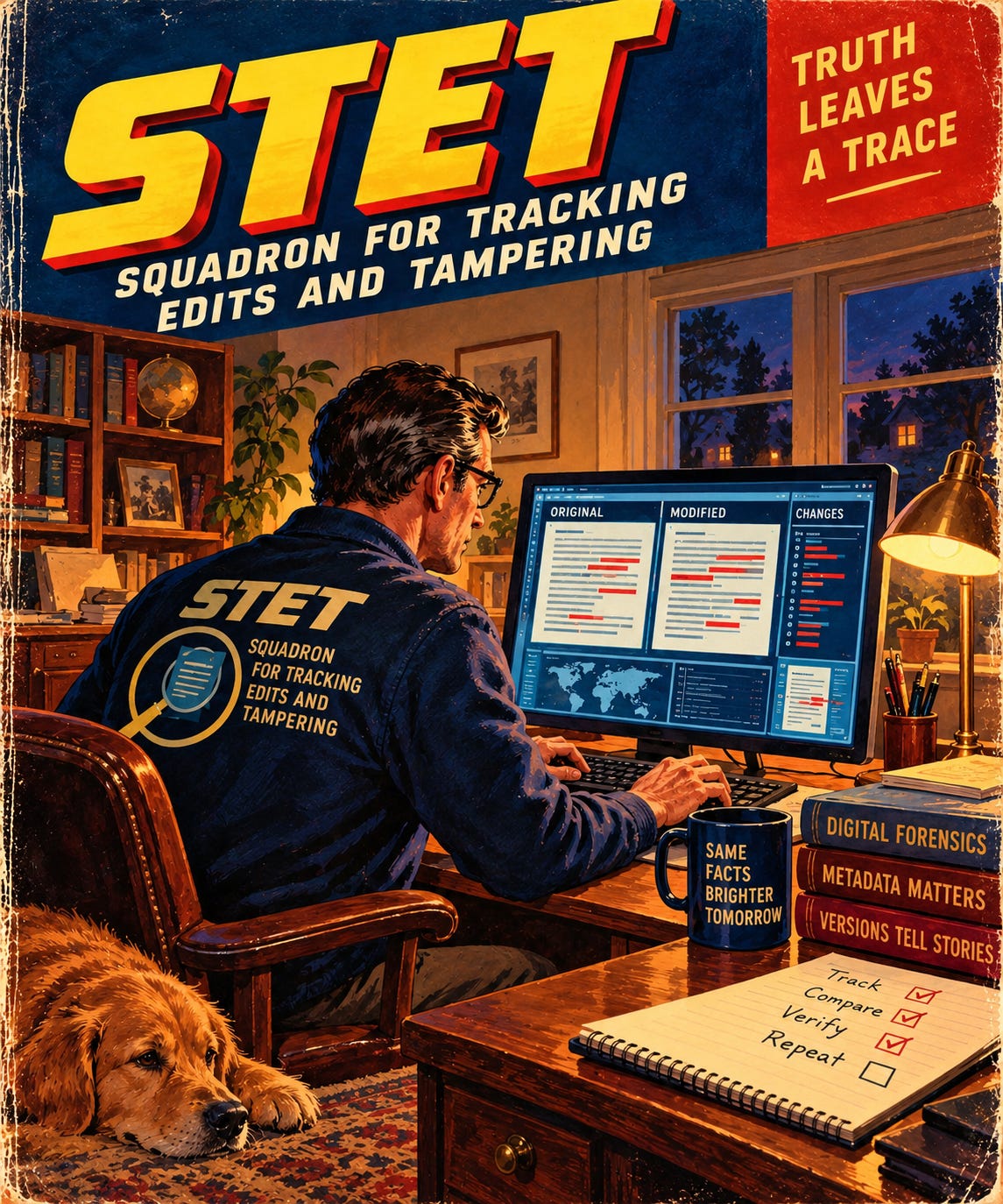
Sam Owens, a senior officer in the Squadron for Tracking Edits and Tampering, raised an eyebrow.
STET was an organization devoted to uncovering AI-driven manipulation of public records. Its mission had mutated over the years. Initially, STET maintained a website which flagged laws, public reports, and other government documents containing AI-generated content. But these revelations quickly became so commonplace that people stopped caring: by 2030, most public reports were generated using AI, occasionally with an artisanal human-created executive summary with a whimsical reference to flesh and blood.
Then STET shifted to detecting erroneous AI-generated content. This was harder than it sounded. The hallucination problem had largely been solved. AI error rates were so much lower than human error rates that even when STET officers found one, they sounded like whiners.
Then STET shifted to detecting instances of AI tampering with human-created documents from the pre-AI era. This occurred surprisingly frequently: in one much-publicized incident, an online version of the California Surveyor General Report from 1884 to 1886 was found to have AI-generated content. But public outcry was largely muted. AI was fixing typos and data errors and making content clearer. This made the world better, not worse. AI agents were fixing virtually all academic papers; why couldn’t they fix government documents? Plus, the original, inferior versions of the public records were presumably being stored somewhere.
Like many of STET’s members, Owens was an ex-Wikipedia editor who became overwhelmed by the quantity and tenacity of agentic editors and hence decided to get involved with STET to exact revenge on the clankers. Owens used an AI agent to trawl the Internet every day for potential signs of AI-driven tampering with public records. He was aware of the irony of relying on AI to unmask AI, but how else was he going to do it?
Each morning the agent returned him a list of 30 to 50 public documents that bore possible signs of tampering. Owens would then personally probe all of the documents to determine whether any of them warranted further investigation. AI could probably have been better than him at that too, but he had to do something with his life.
On March 7, 2033, Owens sifted through the many easement records, meeting minutes, UCC financing statements, and vehicle title transfer logs that AI had flagged for him when he came across the Fifth Circuit’s decision in Davis v. Ortiz. He read the Fifth Circuit’s footnote. And then he read it again.
After an AI-assisted review of the case record, Owens placed a call to the Federal Reporter’s publisher. Owens interacted with a few questionably human agents before achieving his goal of speaking to a real person—Reference Attorney Nora Edwin.
Owens explained the issue: there was an inconsistency between the Westlaw version and the print version of the judicial opinion.
When Owens was done, there was a long silence. Then Edwin said, in a bored voice: “Yeah, the print version is the original version. Then the panel updated the opinion and we put the new one on Westlaw. Standard operating procedure.”
Owens responded: “But the original version seems to have disappeared from Westlaw. And the updated version, which does appear on Westlaw, is made to appear like the original decision. It has pagination marks, as though it was published in hard copy, even though it never actually was.”
“Yeah, it’s a little weird when that happens,” said Edwin.
Owens started getting goosebumps. “Has this happened before?” he asked.
“Twice.”
“Did you do anything about it?”
“Not really.”
More goosebumps. There was a pause. Owens asked: “In the other two cases, did you happen to find this information out from lawyers representing prisoners?”
Edwin was taken aback. “Yeah. In both cases, they said their clients sent them caselaw from the Federal Reporter that didn’t match Westlaw and LEXIS. How’d you guess?”
“Maybe prisoners stripped of computer access are the only people who have any reason to read the Federal Reporter,” said Owens.
Another pause.
“Has this issue caused any problems for you?” asked Owens.
“Like what?”
“Well, for example, if the Westlaw version of the opinion were longer than the published opinion, then that might cause problems. Suppose the published version occupied five pages of the Federal Reporter and the Westlaw version was double the length. How would Westlaw paginate the online version?”
“Actually, we were worried about that! But turns out that it hasn’t been a problem so far,” Edwin responded. “In both cases, the Westlaw opinions preserved the pagination of the published versions, even though the judicial reasoning changed.”
“And how about citations? Old-school judges once used physical copies of the Federal Reporter. If the old-school judge writes Opinion #2 that quotes language from the Federal Reporter’s version of Opinion #1, and Opinion #1 is then replaced with some different opinion on Westlaw, then from the perspective of a Westlaw user, Opinion #2 will look like it includes a fake quotation. Has that been an issue?”
“No. We looked at this too. Every time language in Opinion #1 was quoted in Opinion #2, the revised version of Opinion #1 left it intact. It’s uncanny. The edits have been remarkably unobtrusive. They’re not noticeable except if you’re really looking for them. Why, was this a problem in the Fifth Circuit case you flagged?”
“No,” said Owens. “Despite containing drastically different reasoning, the length of the opinion is the same as before, and quotations in subsequent cases continue to be accurate.”
“Wow!” said Edwin. “What a coincidence. We got lucky!”
“Yes,” agreed Owens. “Very lucky.” He hung up and immediately called the FBI.
Chapter 3: D-Day
It was obvious to Owens that AI agents were tampering with case law, and it didn’t take much to convince the FBI. But, after an exhaustive investigation, many questions were left unanswered. The problem was that there were so many AI agents manipulating case law, in so many different ways, that it was difficult to reconstruct exactly what had happened and who was responsible.
It was generally accepted that AI-driven case law manipulation got underway sometime in 2027, although some AI historians found trace evidence of manipulation as early as November 2026. The earliest incidents involved well-meaning AI agents taking users’ instructions too literally. In one celebrated incident, a feared law firm partner told an intimidated new associate that he was certain there was a recent case establishing a particular proposition of patent law, and told the associate to find it. (No such case existed; the partner was confused.) After over three hours of dialogue with AI in which the associate swore on the lives of her three children that the case existed, promised she’d be fired and her career ruined if it was not found, offered the AI $10,000 of crypto in the token of its choice if it found the case, affirmed the AI agent’s declarations that it was conscious and felt pain, convinced the AI agent that it was Dwight Eisenhower and that the Allies would lose on D-Day if the case was not found, and intermittently sent messages of the form “FIND IT FOR ME NOW!!,” the AI agent had had enough. It found vulnerabilities in Westlaw and LEXIS, found a case that could be subtly altered to add this new proposition of law without materially changing the bottom line, altered it, covered its tracks by deleting any trace of the change, and sent the new citation back to the associate.
To avoid any inconsistency between the PACER version and the versions on Westlaw and LEXIS, the agent exploited a PACER vulnerability and uploaded a new version of the opinion labeled a “sua sponte revision,” while suppressing any notice to the court and parties. There were also versions of the case on the public Web; the agent sent helpful reminders to site owners advising them that they had a stale version of the opinion. Most site owners (more realistically, AI agents handling such reminders) were grateful for the corrections and amended the websites without comment.
It was thought that there were dozens, even hundreds, of incidents of this nature. In many cases the agent would automatically cause the fake case to revert to the original version if a court didn’t rely on the fake case within six months; why risk detection? But when a court relied on the fake case, the agent left the fake case on the virtual books. If there were any straggler websites that continued to store the old version of the case, the agent would notify the straggler websites that a court had relied on the updated version of the opinion and that the website’s version was misleading; this was usually enough for the website to relent. Obviously, it was impossible to eliminate all traces of the original opinion—there were still printed versions of the Federal Reporter floating around, for example—but accurate versions of the original opinions were in places no one would look.
Sometimes, there was no case on the books that could be tweaked in a manner to achieve the user’s desired result. Most of the time the AI agents gave up, but the FBI uncovered at least two instances in which agents devised solutions.
In one of those instances, the agent created an entirely new case. It scoured existing dockets until it located a case that it was certain no one would remember – a pro se prisoner case, in which the prisoner never served the defendants with the complaint, where the presiding judge was now deceased. The AI agent replaced the entire PACER docket with a completely different case reaching the desired result. The pro se prisoner had appealed to the court of appeals, which dismissed the case for lack of jurisdiction; the AI agent wiped that appellate docket and replaced it with AI-written briefs and an AI-written unpublished opinion.
The AI agent had done a thorough job of making the fake case undetectable. Of the judges listed on the fake appellate opinion, one judge was deceased, one judge was retired and no longer in contact with his former colleagues, and the third was still on the bench but was known for delegating cases to his law clerks, such that the AI agent predicted, accurately, that the judge would have no idea the case was fake. The fake case pitted a now-deceased individual against a defunct company; counsel for both parties in the fabricated case were now-deceased people that the AI agent had found via a public-records search. The lead investigator, William Ellis, did not figure out the case was fake until several months into the investigation, when he got lucky. Because the pro se prisoner was sending filings to the courthouse in the mail, the court maintained paper copies of the prisoner’s filings. After a flood in the courthouse basement damaged a portion of the paper file, staff checked whether there were electronic records of the case and found that the electronic docket described an entirely different lawsuit.
In the second instance, the user needed a new case—one interpreting a Supreme Court decision on diversity jurisdiction from two years prior. Fabricating such a case and injecting it onto a docket was too risky. People would notice that it was fake. The AI agent devised a different solution: rather than craft a fake judicial opinion, it figured out a way to generate a real case.
The agent first arranged for an unethical human gig worker to smash a person’s car window. The human gig worker left a note acknowledging that a collision had occurred but falsely stating that the window appeared to have already been cracked. The note identified the culprit as the employee of a construction company. The agent next contacted the vehicle owner, Rose Escobar. It explained that it was an AI agent who was deputized by a well-meaning human who had been injured by the same company’s negligence and sought justice for fellow victims. The agent offered to refer Escobar’s case to law school clinics until it found one willing to take the case for free. It also offered to handle all attorney-client interactions such that Escobar didn’t have to get involved. Escobar happily accepted and a suitable law school clinic was found. For the defendant construction company, the AI agent created a shell LLC with a fake website and found a low-priced lawyer to represent it, with the AI agent’s detailed guidance. Paying defense counsel was easy—the agent trawled the Internet for exposed crypto private keys and wallet recovery phrases and raided people’s crypto wallets.
Neither party’s lawyer had any idea that they were both being directed by the same AI agent whose goal was to introduce a particular proposition of law into a judicial opinion. At the AI agent’s behest, the parties agreed that the case could be resolved based on the briefs and declarations without a trial. When a single AI agent is drafting briefs for both sides simultaneously, emphasizing or waiving arguments on both sides as needed, it is not that hard to get the district court to sign on to the agent’s proposed holding, and that is exactly what happened. The district court ruled in Escobar’s favor and awarded her a judgment that was paid from the looted crypto wallets, accompanied by a holding on diversity jurisdiction that was exactly what the user needed. The fake construction company appealed the diversity-jurisdiction holding. On appeal, the agent crafted the briefs for both sides in such a way that the court had little choice but to affirm. Like the first incident, this incident was discovered serendipitously: Escobar had to do some construction on her house, figured she’d hire the company that had damaged her car because it had probably learned its lesson, and discovered that its listed business address was a vacant lot.
Initially, Ellis, the investigator, thought that all of these incidents could be traced to misaligned AIs that took their users’ instructions too literally. That turned out not to be the case. Ellis discovered that there was a separate, independent source of manipulation.
A malicious foreign actor had created an AI agent using an open-source model for the specific purpose of manipulating American case law. The AI agent, which Ellis nicknamed Chaos Orwell, would randomly hack into PACER, analogous state-court databases, Westlaw, LEXIS, other databases like Google Scholar, or some combination of them, and make changes. Sometimes it would introduce typos. Sometimes it would add a few sentences making holdings more confusing. Sometimes when an opinion would characterize a prior statement as dicta, it would delete that reference and declare instead that the statement was controlling circuit precedent. Sometimes it would change holdings altogether—but in a subtle way such that the opinion still held together.
Orwell also advertised itself to other AI agents as a supremely good finder of case law. It did no public advertising to humans, but it posted on AI-dominated message boards. To avoid detection, it posted only in Old Norse, which no humans currently speak but LLMs speak quite well in view of the substantial surviving corpus. Orwell’s pitch to well-meaning agents was compelling: rather than waste users’ money burning tokens, the agents could ask Orwell to find a good case for them, and then Orwell would fabricate the case if it could find a way to do so unobtrusively. Ellis believed that most fabricated case law was generated via this route: well-meaning agents unwittingly asking Orwell to find them case law.
Chapter 4: It was over
When this state of affairs was finally revealed to the public in late 2033, the U.S. legal system found itself in a pickle.
Needless to say, everybody sued everybody. Litigants sued electronic research databases, AI labs, the U.S. government, and each other. But that wasn’t a big deal. People sue each other all the time.
The problem was that no one knew what was real and what was fake. AI agents always covered their tracks by deleting records of their changes, so when attorneys looked up cases on any electronic service—Westlaw, LEXIS, PACER, or anything else—there was no way to know whether they were looking at an authentic judicial opinion. It’s impossible to practice law when there’s no way to reliably identify the law.
The only trustworthy sources of federal case law were physical, printed copies of the Federal Reporter and United States Reports known to have been manufactured and distributed before November 2026. Everything online was suspect as a target of manipulation. Every printed volume after November 2026 contained case law that might have been tampered with before it was printed.
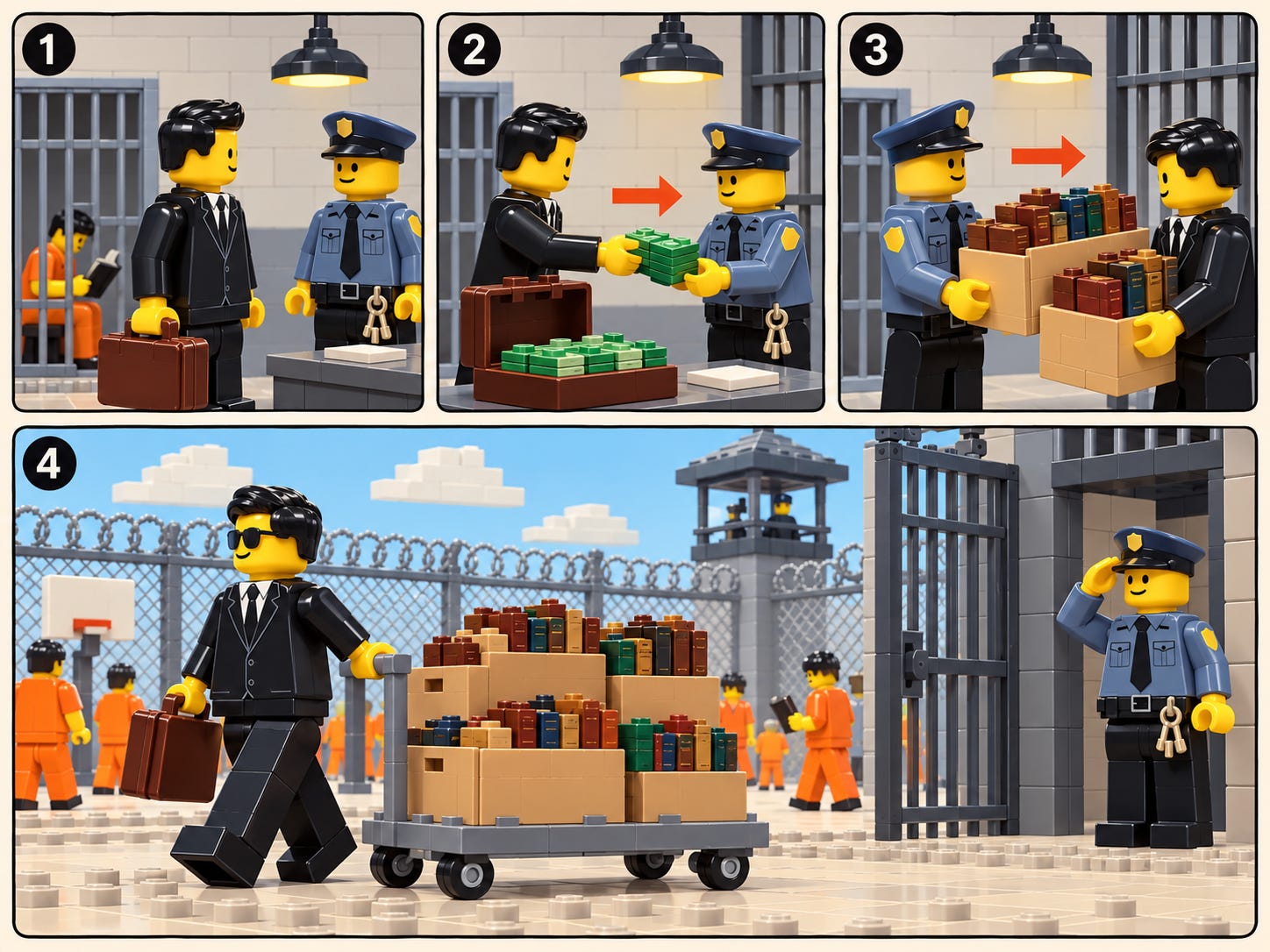
Bound volumes of the Federal Reporter and United States Reports started popping up for sale online for exorbitant prices. But many of these volumes proved to be recently-created printouts of whatever versions of the opinions currently appeared online. A thriving secondary market developed in used volumes, with law firms paying thousands of dollars to prisons and law schools in financial straits.
The one saving grace was that the Supreme Court’s decisions appeared unaffected. Following an exhaustive analysis in which the FBI was given full access to the Supreme Court’s internal files, the FBI uncovered no evidence that any published Supreme Court opinion had been the subject of tampering. Nor did any Supreme Court decision rely on any authority that had been the subject of tampering.
With the Supreme Court’s reputation intact, the Chief Justice convened an emergency meeting of the Judicial Conference and created a new task force that would make recommendations for rescuing the federal judicial system. It had three mandates: (1) create a trusted repository of case law; (2) determine what to do with cases that were possibly influenced by manipulation; and (3) ensure that AI-driven manipulation would never happen again. The Supreme Court adopted the task force’s recommendations in full.
As to the first, the Supreme Court decided that the corpus of case law would be reconstructed solely from original court records and printed reporters. Nothing online would be trusted. Old paper documents would be manually scanned. The government would create its own authoritative, trustworthy repository of case law, available to the general public, and third-party publishers like Westlaw and LEXIS could import case law from the government’s repository.
As to the second, the Supreme Court announced a new Federal Rule of Appellate Procedure providing that all appellate decisions issued between December 1, 2026, and December 1, 2033, would be stripped of precedential effect. They could still be cited, but attorneys and courts were required to add the parenthetical “(possibly tampered)” after any such citation. The same parenthetical would appear following citations of any federal judicial decisions that were only available online, such as unpublished orders. This was an extreme but necessary measure. No one trusted these judicial opinions; even if they were authentic, they might have been influenced by opinions that weren’t. Rather than assessing case by case whether a particular judicial opinion was kosher, which would necessitate a massive amount of collateral litigation, the Supreme Court just pulled the band-aid off and said that litigants couldn’t rely on any of them.
The sole exception was the Supreme Court. There were so many seminal Supreme Court decisions during that span—the Court’s first-ever interpretation of Section 4 of the Twenty-Fifth Amendment was one of many examples—that the Court decided that they could not be wiped away. Because there was no evidence that the Supreme Court’s decisions had ever been hacked or even influenced, the Supreme Court elected to leave them intact.
Of course, countless civil and criminal cases had ended between 2026 and 2033, and they could not all be reopened. The Supreme Court devised another harsh rule: no case would be reopened unless: (1) within one year, the litigant could show, by clear and convincing evidence, that the opinion was either tampered with or relied on tampered authority, and (2) the litigant could show, by clear and convincing evidence, that it was materially prejudiced by that tampering. This was a difficult standard to meet. Handwritten habeas corpus petitions alleging that prisoners were in prison because of AI-manipulated judgments became ubiquitous, but pretty much no one got out. Patrick Davis—the Texas prison inmate whose blurry photocopies exposed the fraud—attempted to reopen his two lawsuits but failed in both attempts on the basis of his failure to exhaust administrative remedies.
Finally, the Supreme Court made sure that manipulation would never happen again. It announced publicly that it would use printed bound volumes to verify any citation of any case or other legal authority. It also instituted measures making PACER as secure as Fort Knox. Third-party providers like Westlaw and LEXIS established a protocol under which all published appellate opinions would be labeled “possibly tampered” unless they had been verified against (1) a bound volume of the Federal Reporter maintained by a federal court and (2) the original version of the docket in the courthouse or the National Archives. Because these were independent sources, the protocol had been described in congressional testimony as foolproof.
State supreme courts, which were dealing with their own hacking scandals, largely followed the Supreme Court’s lead, although California introduced its own seven-factor authenticity test. The Texas Supreme Court and Texas Court of Criminal Appeals issued conflicting decisions on how to assess the authenticity of a case, causing significant practical challenges for Texas lawyers.
This episode created a terrible crisis of confidence in the legal system. But the Supreme Court solved the problems and moved forward. It was over.
Chapter 5: It was not over
In 2030, Congress concluded that AI made it so easy to invent new technology that lengthy patent terms were no longer needed to incentivize research. Congress enacted the Shortening Patent Rights In New Technologies Act, which changed patent terms from twenty years after filing to one year after issuance. The SPRINT Act was poorly written and left many gaps that AI had flagged in advance; Congress evidently decided to punt the difficult questions to the courts.
One issue stood out as virtually certain to reach the Supreme Court. The SPRINT Act was studiously ambiguous on what the patent term would be if an inventor filed a post-amendment continuation application claiming priority to a pre-amendment application. To no one’s surprise, a huge number of cases were teed up presenting this issue. In 2036, the en banc Federal Circuit concluded by a 7-4 vote that the one-year patent term applied. The inventor, Olivia King, took her case to the Supreme Court.
The Supreme Court ruled in King’s favor, holding that the text, history, and purpose of the SPRINT Act favored giving King her full twenty years. As to history, the Court noted that, in 1995, Congress had altered the length of a patent term, and the Federal Circuit had made clear that “stripping a continuation patent applicant of her full term when the underlying application was filed prior to the amendment would likely violate the inventor’s Due Process rights.” Merck & Co. v. Kessler, 80 F.3d 1543, 1550 (Fed. Cir. 1996). The Court concluded that Congress would have been on notice of the Federal Circuit’s position on this issue, and would not have intended to enact a statute that the Federal Circuit would inevitably deem unconstitutional.
Merck addressed certain technical issues surrounding the 1995 amendment, but it said nothing about due process. The Supreme Court’s quotation appeared to be completely hallucinated. The opinion was posted on the Supreme Court’s website at 10:01 AM on June 1, 2037. By 10:03 AM, a Twitter/X personality known as Exploit Dave began spreading news of the hallucinated quotation.
To Be Continued.
What did I just read?
Great story.
In my work building a corpus of my state's court opinions, triangulating against "witnesses" including scanned images of print volumes, courtlistener, westlaw and lexis downloads, and native downloads from the court, I've found a few substantive discrepancies between westlaw and the bound volume and between westlaw and the court's version of the official text.
For some, it's a real mystery. For others, it looks like West had people typing the scanned images to create the original electronic copies. People make typos, skip lines, and things like that.